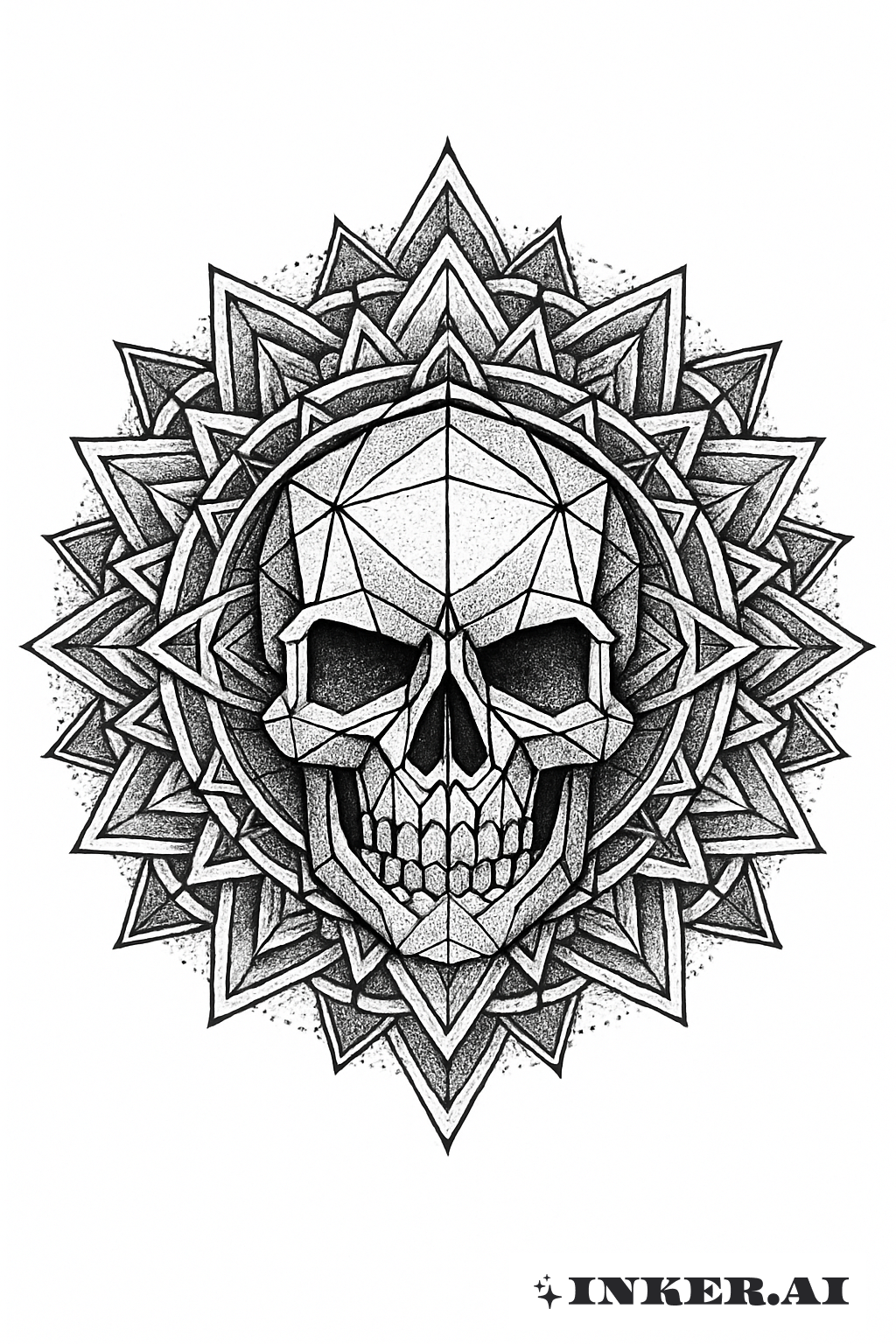
Cultural Meaning Of Mandala Pattern With A Central Totenkopf Tattoo Design
The central skull serves as a potent reminder of mortality, framed by the mandala's circular order that symbolizes eternity and the cycle of life. Combining a memento mori motif with patterned repetition creates tension between transience and permanence: the skull points to individual decay while the mandala evokes cosmic balance. In many traditions mandalas are meditative tools; surrounding a skull with this structure invites contemplation of life, loss and personal transformation. Executed in a geometric tattoo style, the design emphasizes calculated balance—each ring and motif reflecting an aspect of the self or stage in life's passage. Artists and clients draw from classic flash and contemporary minimalism when selecting among skull tattoo ideas that blend symbolism with aesthetics. Depending on shading and scale, the piece can read as sombre and introspective or ornamental and decorative, allowing wearers to claim its meaning privately or display it as a bold philosophical statement.
Design Inspiration Of Mandala Pattern With A Central Totenkopf Tattoo Design
Inspired by sacred symmetries and traditional memento mori imagery, this piece merges precise patterning with bold iconography. The artist explored contrasts—hard edges against soft stippling, dense black against open negative space—to make the skull both central and integrated. References range from classical mandala ornament to modern blackwork and fine-line tattooing; the goal was a design that is at once contemplative and decorative. The result is a versatile motif that can be scaled or simplified for different placements while retaining its contemplative core.